Physical Address
304 North Cardinal St.
Dorchester Center, MA 02124
Physical Address
304 North Cardinal St.
Dorchester Center, MA 02124


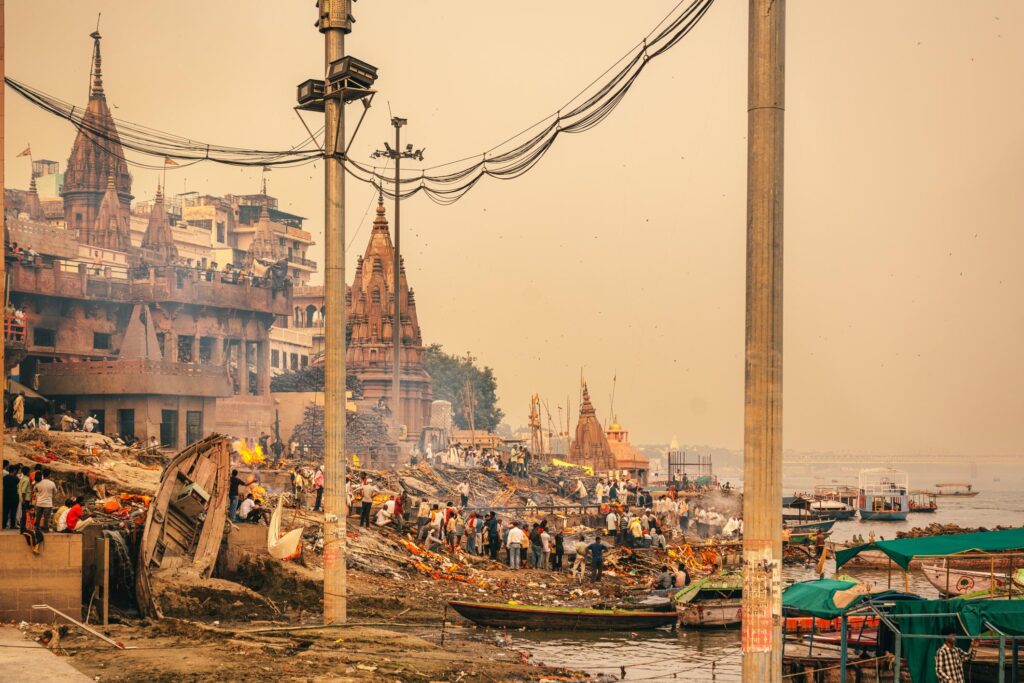
Varanasi, also known as Kashi and Banaras, is one of the world’s oldest continuously inhabited cities. Situated on the banks of the sacred Ganga River in Uttar Pradesh, India, it is regarded as the spiritual capital of India. For thousands of years, Varanasi has been a center of religion, philosophy, education, music, and culture.
The history of Varanasi dates back more than 3,000 years, though Hindu tradition believes it is over 5,000 years old. According to mythology, the city was founded by Shiva, making it one of the holiest cities in Hinduism. The name “Varanasi” comes from two rivers — Varuna and Assi — that flow into the Ganges.
Varanasi is mentioned in ancient Hindu scriptures such as the Rigveda, one of the oldest sacred texts in the world. By the 6th century BCE, it had become an important urban center and a major hub of trade and learning.
Varanasi also holds great importance in Buddhism and Jainism. In the 6th century BCE, Gautama Buddha delivered his first sermon at Sarnath, just a few kilometers from the city. This event, known as the “Dhammacakkappavattana Sutta,” marked the beginning of Buddhism as a formal religion.
Similarly, Jain tradition states that several Tirthankaras, including Parshvanatha, were born in or around Varanasi. Thus, the city became a shared spiritual ground for multiple religions.
During the medieval period, Varanasi faced several invasions. In the 12th century, the city came under the rule of Muslim dynasties. Many temples were destroyed during invasions, but the spiritual significance of the city never faded.
Under the Mughal Empire, especially during the reign of Akbar, there was relative tolerance, and some temples were rebuilt. However, during the rule of Aurangzeb, several temples were again demolished, and mosques were constructed at certain sites.
Despite political turmoil, Varanasi remained a center of Sanskrit learning, classical music, and devotional movements such as Bhakti.
In the 18th century, the Marathas played a significant role in rebuilding temples and ghats (riverfront steps). The famous Kashi Vishwanath Temple was rebuilt in 1780 by Queen Ahilyabai Holkar of Indore.
During British rule in the 19th century, Varanasi became part of the British Indian administration. Though political power shifted, the city retained its cultural importance. Educational reforms led to the establishment of modern institutions like Banaras Hindu University in 1916 by Madan Mohan Malaviya. BHU became one of Asia’s largest residential universities and a major center for higher education.
Varanasi is famous for its ghats — over 80 riverfront steps leading to the Ganges. Important ghats include Dashashwamedh Ghat and Manikarnika Ghat. Every evening, the spectacular Ganga Aarti ceremony is performed, attracting thousands of devotees and tourists.
The city is also renowned for:
It has been home to great saints and poets such as Kabir and Tulsidas, who composed the Ramcharitmanas here.
After India gained independence in 1947, Varanasi continued to grow as a major pilgrimage and cultural center. In recent years, infrastructure development and riverfront beautification projects have modernized parts of the city while preserving its ancient charm.
Today, Varanasi stands as a symbol of continuity — where life and death coexist. It is believed that dying in Varanasi brings moksha (liberation from the cycle of rebirth). Cremation rituals along the Ganges have been performed here for centuries, reinforcing its reputation as the “City of Light.”
Varanasi is not just a city; it is a living museum of Indian civilization. From Vedic chants to Buddhist teachings, from Mughal architecture to modern universities, the city reflects layers of history spanning millennia. Its spiritual energy, sacred river, ancient temples, and vibrant culture make it one of the most unique and enduring cities in the world.
For anyone seeking to understand India’s spiritual and cultural roots, Varanasi remains timeless — truly an eternal city.
